
The Human View™ Blog

Q. What is Psychographics?
A. It's a system that supports Motivational Profiling and messaging.
(And it's the question every “engagement strategy” should have to address)
Every benefits leader says they care about engagement. But far too few are willing to test whether the plan they're using actually delivers enough of it.
I'll start with a definition: Psychographics is the practice of segmenting people by what actually motivates them — their relationship to risk, their relationship to authority, how they process a decision, what kind of message makes them lean in versus tune out. This - obviously - goes beyond demographics, age, gender or job title.
Motivational messaging is what you build once you know your audience(S). Because your "audience" is NOT homogenous. Better: orient your communications by transmitting on the frequency your people are already listening for: the psychology of the recipient, not the org chart they sit in.
That's the concept. Here's the harder part.
Most of what gets called an “engagement strategy” is a single message, sent to everyone. Same open enrollment email to the risk-averse 58-year-old as what gets sent to the optimizing 29-year-old. Same webinar invite to the person who trusts authority as to the person who trusts peers. We call it “engagement” because “communication” sounds too plain. But the mechanism has been the same, for years: one message, broadcast wide, hoping enough of it sticks.
Why demographics is wholly inadequate
No thinking / feeling benefits professional could defend the idea that a 23-year-old pregnant woman has the same needs as a 23-year-old single male. Demographics ≠ personalization.
None of that is a failure of effort. It's a reasonable response to real constraints — budget, timelines, the fact that segmenting by psychology is genuinely harder than segmenting by zip code or salary band. This was understandable when the tools to take the more valuable path weren't available.
They are now.
So here's the actual question, and it's worth sitting with rather than reflexively answering: if a genuinely tailored approach — one built on how your population actually makes decisions, not the demographics they happen to share — were on the table at low cost and reasonable effort, would you take it?
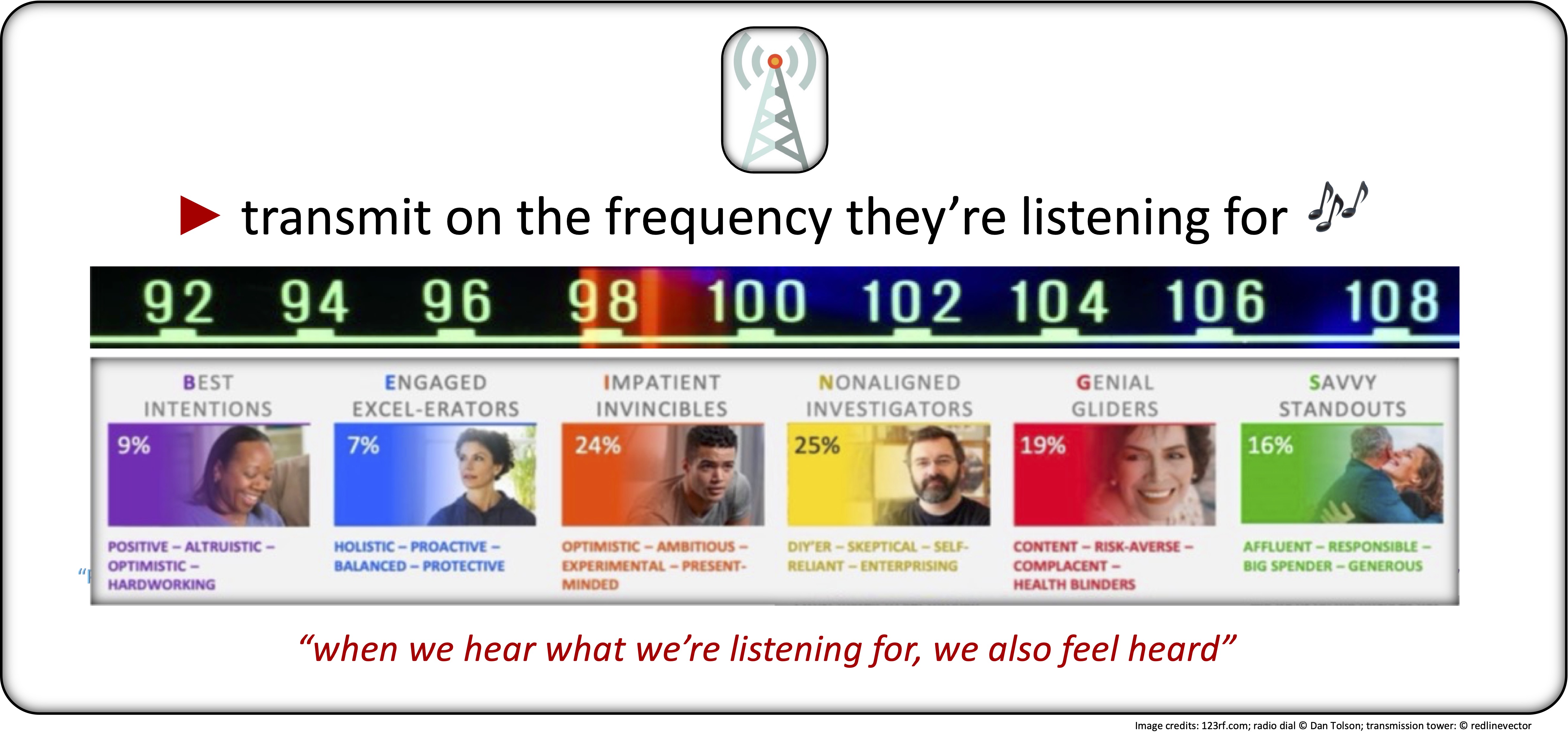
If the honest answer is yes, that's the whole conversation. Psychographic segmentation exists to do exactly that: sort a population into a validated group of six (6) coherent motivational profiles. Once you've done that, you can easily build messaging that speaks to how each group actually decides, instead of hoping a single message works on all of them at once.
Is your honest answer no?
REALLY?

So that says that your desire for engagement is more performative affirmation than strategic commitment. And, hey, I suppose that's "ok."
But what if you could develop a proven reporting framework for your key stakeholders that demonstrated your ability to "knock the ball out of the park?"
If your answer to "Why don't we have more engagement?" is "Well, it's a pickle!"
Then my response back is, "Not if you're committed to something better."

The last word
We build for the first group: the swimmers; not those just treading water. That's what psychographics and motivational messaging are for — not a rebrand of what the laggards are doing, but a provable mechanism for doing what “engagement” was supposed to mean in the first place.
Want to join us?
~ Mark Head
© 2026. All Rights Reserved.


Mark Head
President
With 4 decades of combined experience in employee benefits consulting, wellness and health management, Head brings a unique combination of dynamic perspectives into a clear vision of where the future of health care is moving - and it's moving towards deeper human connection, awareness, and engagement...
Follow Us On
© 2025-2026 Benefit Personas, LLC. All Rights Reserved.