The Human View™ Blog
Transmit on the Frequency They're Listening For
I bet that pretty much everyone reading this post has heard some version of this lament from HR and Benefits professionals:
“If we could just do a better job of educating our people, they'd make better choices.”
And I've noted it myself, several times in these blogs, because it's not just that we've all heard it, it's that we've all felt it.
Of course education works—up to a point.

The upper limit problem
Every benefits communication effort eventually hits a ceiling. Clearer copy, better design, more channels, earlier timing — all of it helps, and then it stops helping. Past a certain level of basic understanding, no amount of additional education convinces more people to respond to a call to action.
As I've also heard more than once: "If education worked as well as we'd like, there'd be no overweight doctors!"
Which raises the key question: If the people who didn't enroll actually understood the offer, what was missing?
AM and FM
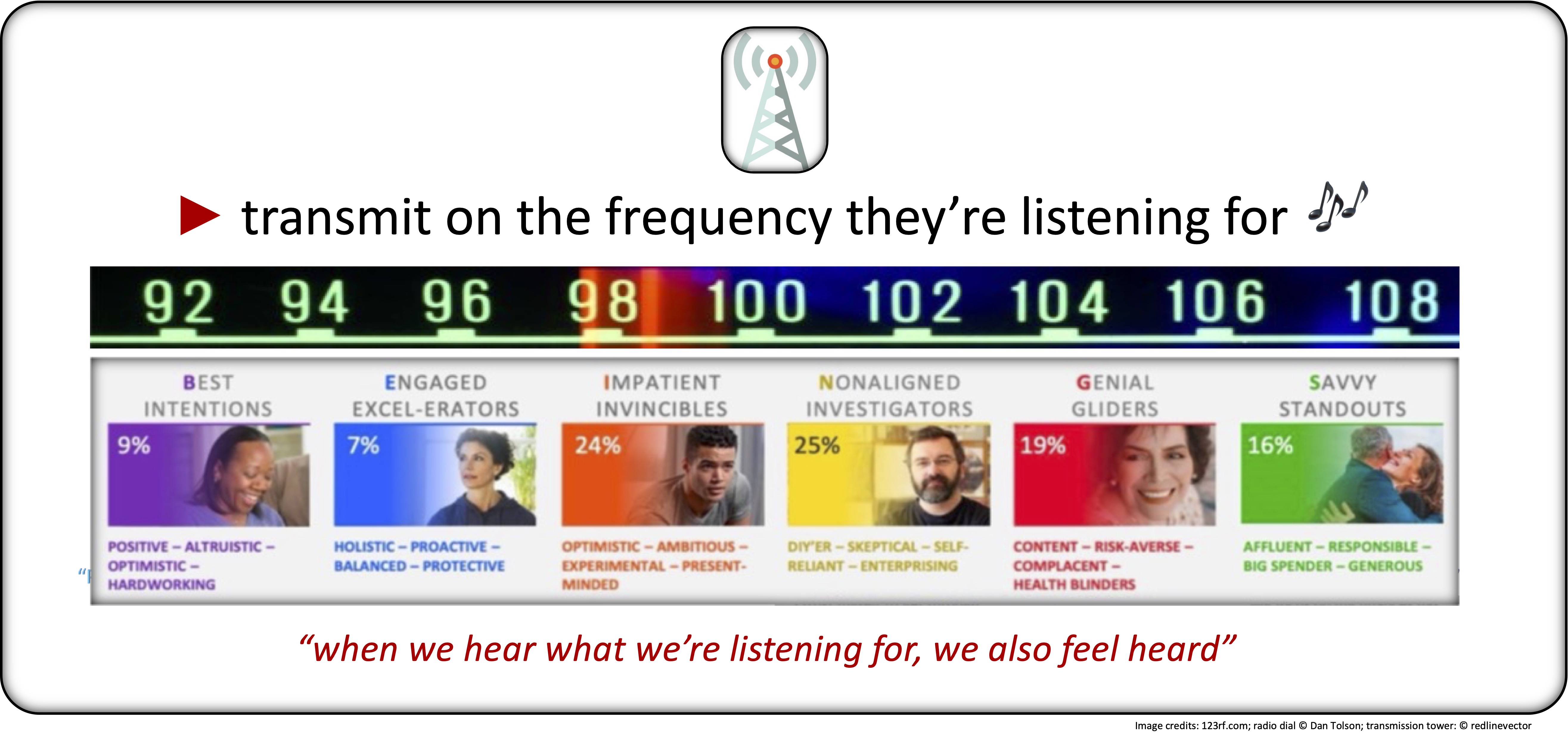
A radio only picks up what it's tuned to. A signal can be true, useful, and beautifully produced, and if it's transmitting at 98.3 while someone is listening to 101.7, none of it gets heard. And that's a functional difference from somebody consciously saying "yes" or saying "no" to the ask.

Two employees read the same paragraph about the wellness program - and it's a good program! But one hears an opportunity to be supported in achieving better health, and another hears the company chastising them for not already being "healthy enough." Same message, but it may well sound like jazz music to a country and western fan - in other words, "UGH!"
The old adage gets at it: it's not what you say, it's how you say it. Education is what you say. Transmitting on the frequency people actually listen to is how you get heard.
Enter psychographics
The entire benefits industry turns on a foundation of demographics: age, gender, job description, location, salaried vs. hourly. There's hardly anything more logical than understanding that a 63-year-old male has different needs and interests than a 23-year-old woman.
We can certainly infer that the guy would be interested in retirement topics, and the gal would at least possibly be interested in understanding the keys to having a healthy pregnancy. What would be far more useful, however, would be knowing that they both want to be as much in control of their situation as possible. Another pair of the same demographic types might both want to be guided by an expert rather than having to do research and figure things out on their own.

Psychographics describe what a person values: beliefs, priorities, world views, how someone weighs risk against effort, whether they lead with duty or independence. Consumer marketers have worked this way for fifty years, and healthcare organizations have used it for a couple of decades to move patients toward screenings, adherence, and follow-up care.
The practical version is plain enough. One employee is focused on personal performance. Another wants peace of mind. A third won't take anyone's word for anything and needs to reason her way to a decision herself. Write the same enrollment email to all three? It'll only really land with one of them.
Two different questions
Serious work already exists here. Mercer's Health on Demand research sorted workers into four segments by their attitudes toward health innovation — Sign Me Up, Impress Me, Get Me Comfortable, Not for Me. Other firms have built comparable models. It's careful research, and it puts the premise beyond argument: people differ in ways demographics can't see, and those differences shape whether a message "works."
That research answers a question about a workforce. What does it "look like?" And that's genuinely useful when you're designing a program or deciding what core health plans and ancillary benefits to offer.
But there's another question that "group-level segmentation" can't answer. Which type is Joe?

Population research was never built to answer that, and was never asked to. Knowing that a quarter of a market listens at a given frequency tells you what kind of station to build. It doesn't tell you who tunes in to which station.
Where it really starts to matter
The difference stops being abstract when we're developing email and text campaigns, or even when we're sending enrollment packages via direct mail.
An email that gets sent on Tuesday morning needs a name and a segment on the same row of the file. So does a text. A segment that exists only as a percentage of a workforce has nowhere to go when the send button gets pressed.
An individually-addressable framework
We've worked with two of the most heavily-researched models that bucket employees into one of 5 or 6 different types. You could even call them archetypes. And that's the deep value: a model that carries the structural property that outweighs every other approach, because a type can be assigned to an individual. Everyone on an eligibility file can carry a segment — which means everyone can receive a version that's been written for why they're likely to care about the topic.

Most useable models carry a "bucketing confidence" of about 65%. Not perfect, but as I like to say - "that's way better" - three to four times better - than random. And because all the messages carry motivational languaging, the only real downside is that it may not "hook" the recipient. Which is the same issue we're already dealing with by trying the hopium that more and better education will yield higher benefits program engagement.
The last word
People obviously need to understand what's on offer. And the compliance calendar isn't going anywhere.
But if the ceiling is real — and most of us have run into it — what sits above it is worth some curiosity. Maybe the answer isn't a better explanation. Maybe it's the same explanation, arriving on a frequency someone was already listening for.
~ Mark Head
© 2026. All Rights Reserved.

Mark Head
President
With 4 decades of combined experience in employee benefits consulting, wellness and health management, Head brings a unique combination of dynamic perspectives into a clear vision of where the future of health care is moving - and it's moving towards deeper human connection, awareness, and engagement...
Follow Us On
© 2025-2026 Benefit Personas, LLC. All Rights Reserved.