
The Human View™ Blog
What the Iran War Means for MRIs — and Your Health Plan
Employee Benefits & Health Plan Strategy
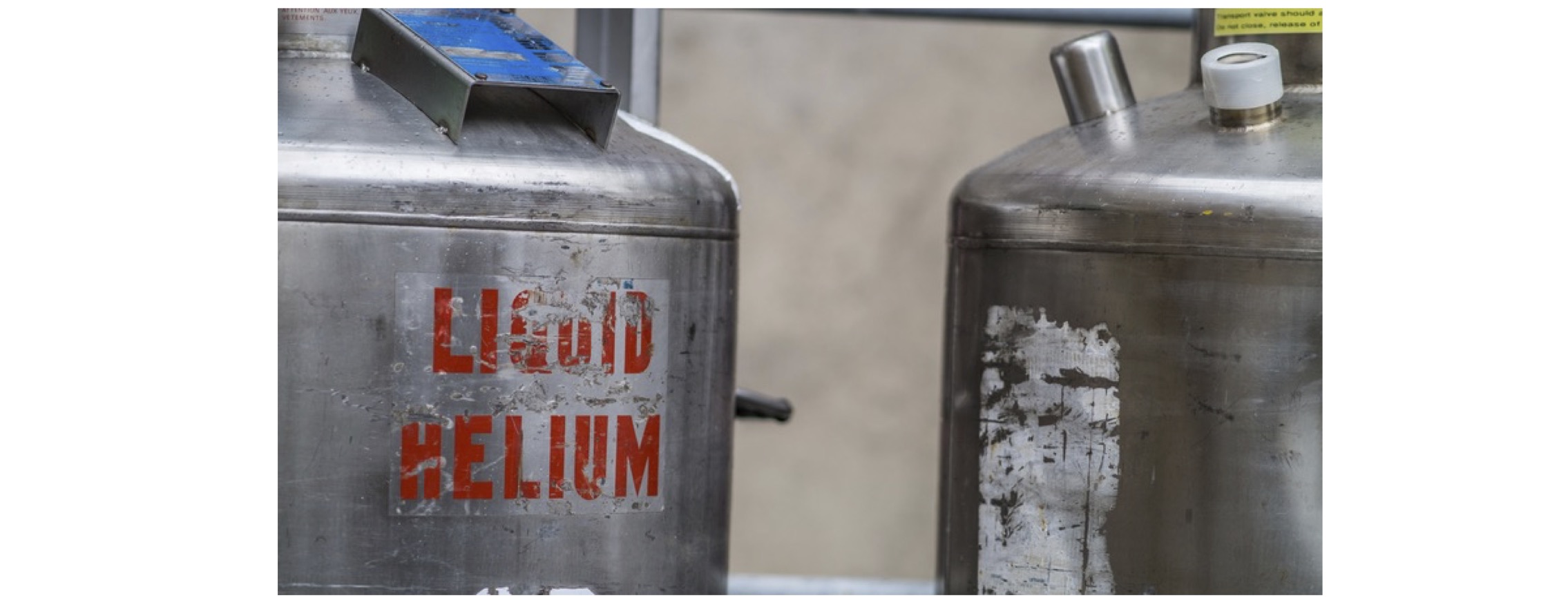
Most people know helium as the stuff that makes balloons float. What most people don't know is that it's also the reason patients can get an MRI. Every MRI scanner on the planet runs on superconducting magnets that must be cooled to –452°F — just a few degrees above absolute zero. Only liquid helium can do that job. There is no substitute.
When Iran struck Qatar's Ras Laffan Industrial City in early March 2026 — the world's largest single helium export hub — it didn't just disrupt energy markets. It put a quiet but real squeeze on medical imaging in the United States.
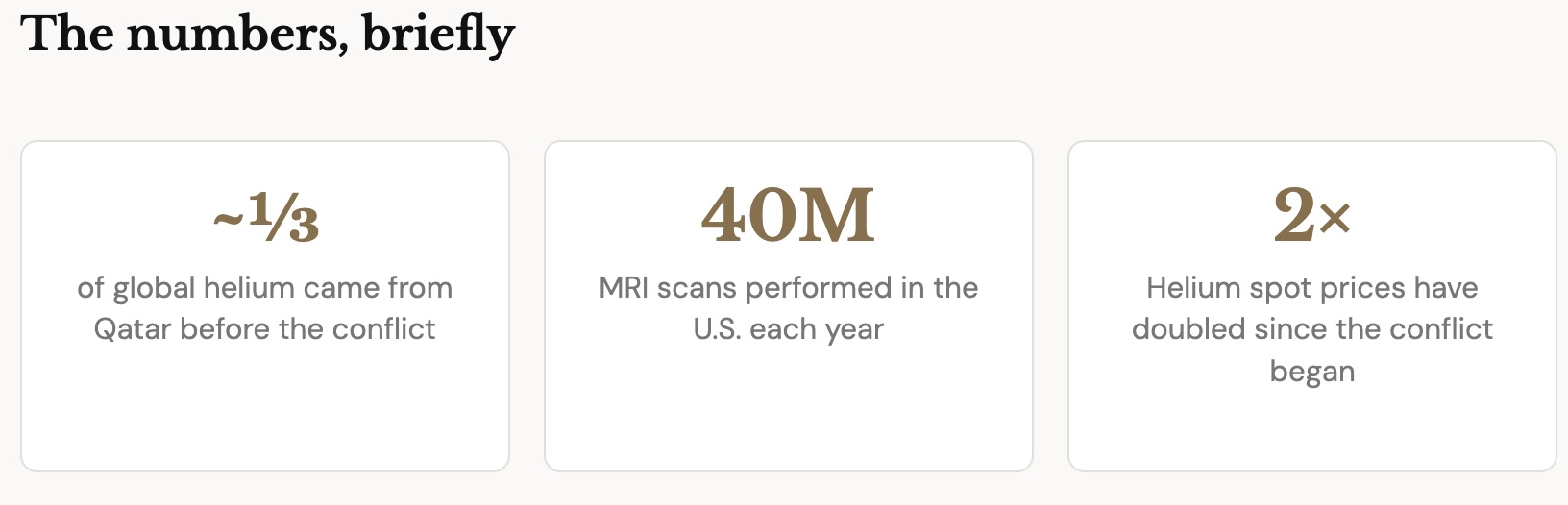
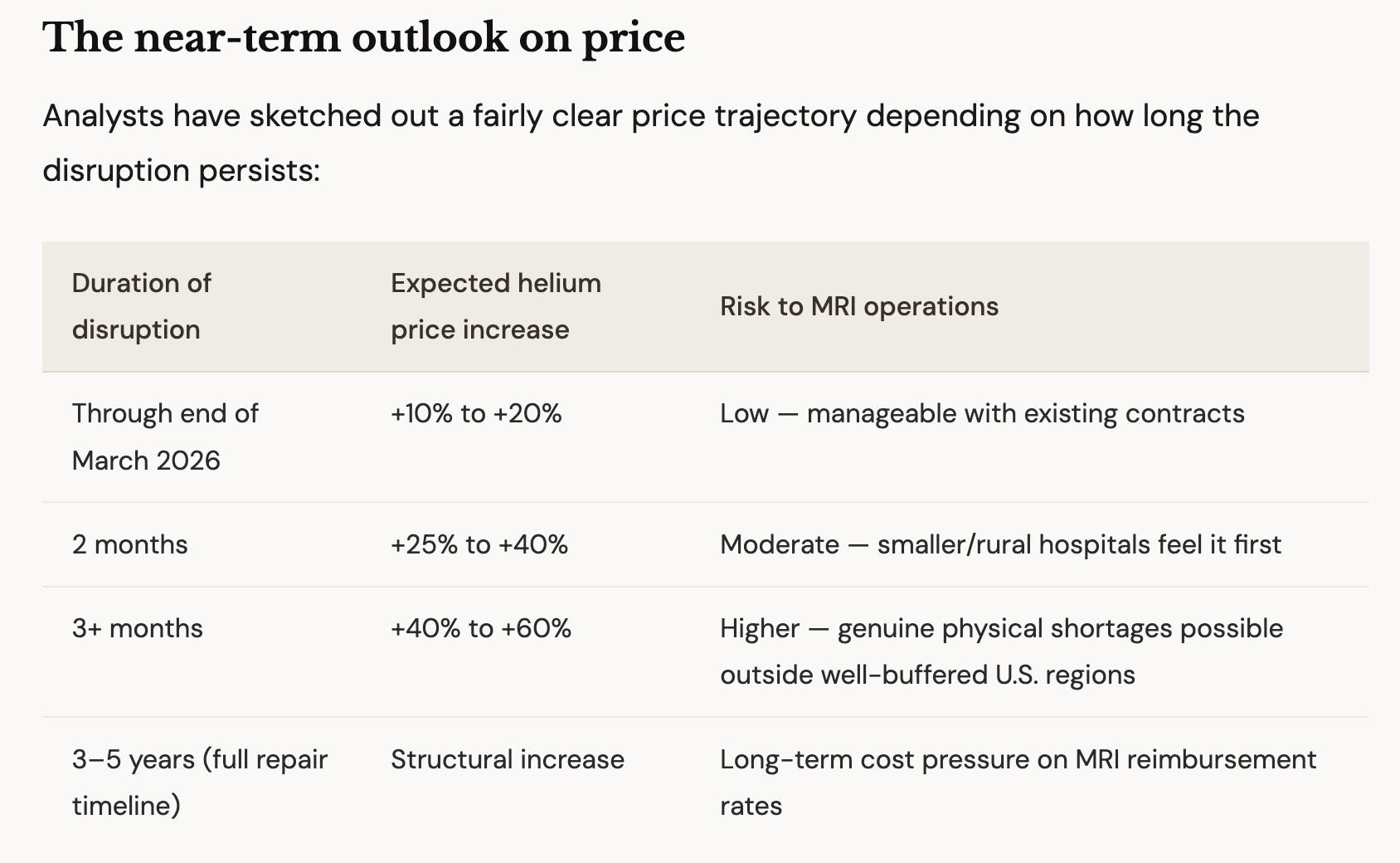
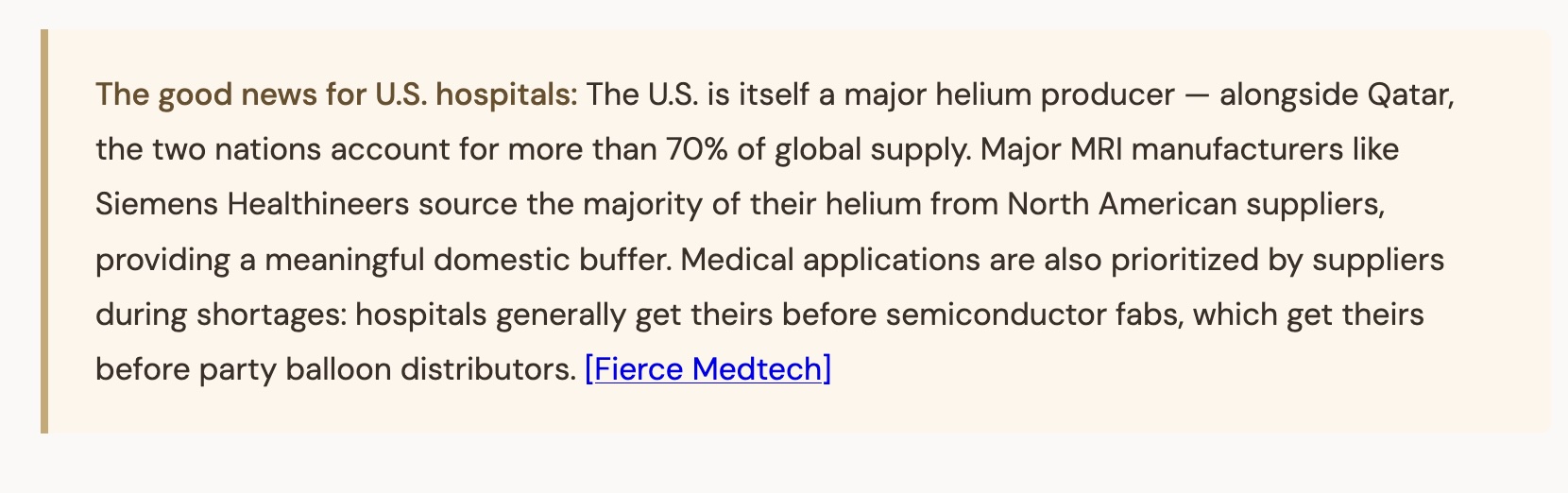
Qatar's state energy company, QatarEnergy, has reported that damage to Ras Laffan could take three to five years to fully repair, with helium exports expected to fall by roughly 14% in the near term. [Fortune] Unlike oil or natural gas, helium can't simply be rerouted or stockpiled indefinitely — the molecule is so small it seeps through even specialized containers, leaving the global supply chain with roughly 45 days of usable buffer before existing inventory boils off. [Middle East Forum]
Source: The National
Where it gets clinically consequential: prostate cancer and 3T imaging
Not all MRI scanners carry the same risk. Standard 1.5T machines are increasingly available in helium-efficient or near-helium-free designs — Philips and Siemens both offer models requiring a fraction of traditional helium. But 3T scanners, which use stronger magnetic fields and hold up to 1,800 liters of liquid helium, have no commercially available helium-free equivalent cleared for use in the U.S. yet. (Philips unveiled a helium-free 3T system at RSNA in late 2025, but it is still pending FDA clearance.) [CNBC]
This matters because 3T imaging isn't simply a "premium" version of 1.5T — it serves distinct clinical purposes. For prostate cancer in particular, 3T multiparametric MRI offers significantly better spatial resolution and staging accuracy, often eliminating the need for an uncomfortable endorectal coil. Studies show 3T mpMRI achieves 86% sensitivity and 99% specificity for detecting and precisely localizing prostate cancer. [Middle East Forum] That precision directly shapes whether a surgeon spares a neurovascular bundle or targets a focal therapy correctly. Degraded staging doesn't just affect the patient — it leads to recurrence, salvage treatment, and long-term costs that dwarf the price of the original scan many times over.
What this means for benefits consultants and plan sponsors
While this may not qualify as a full-blown "crisis," it's a developing situation with a recovery timeline now measured in years rather than weeks. Here's what warrants attention:
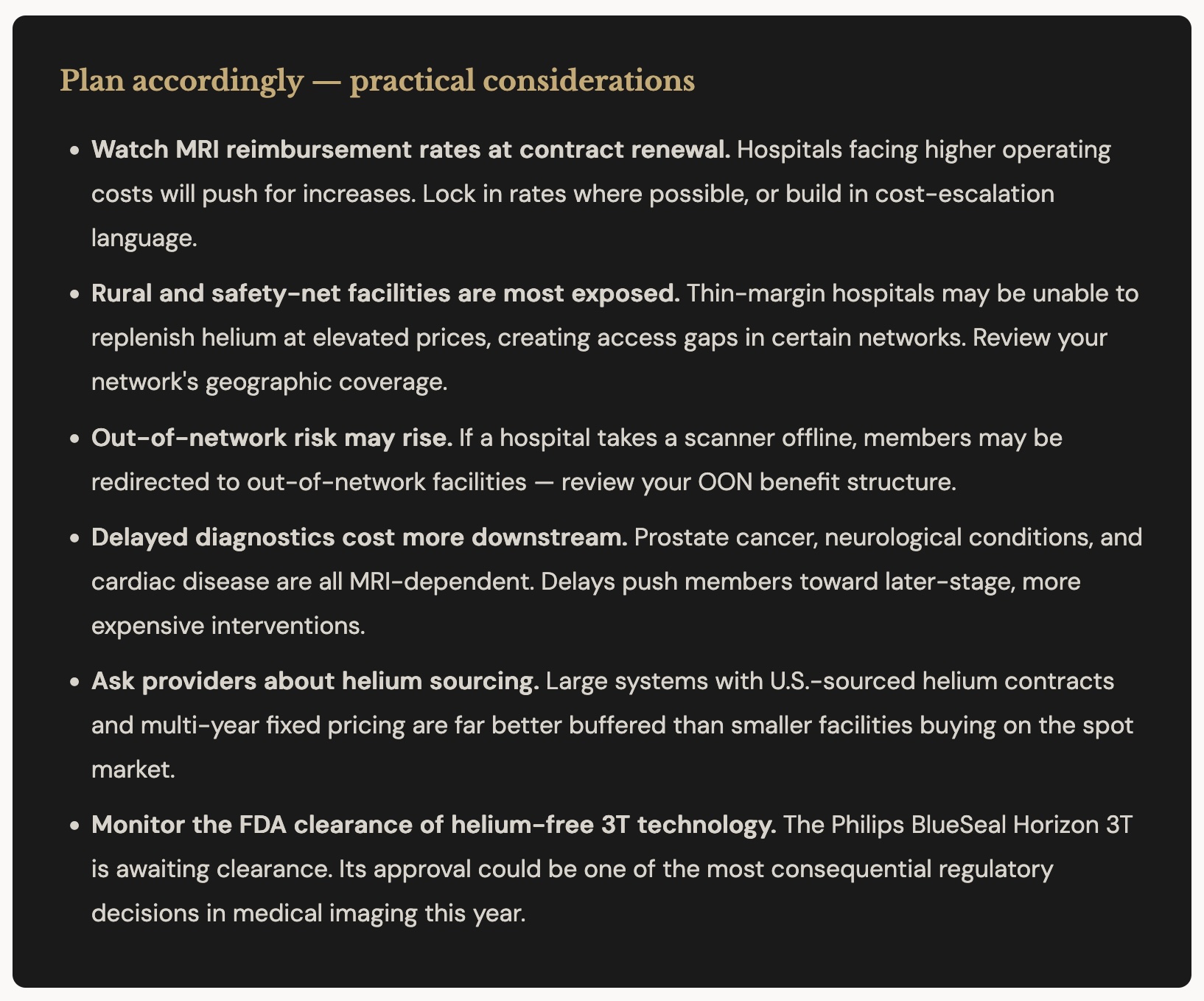
The short version: U.S. hospitals are not facing an imminent shutdown of MRI services. But the combination of doubled spot prices, a 3-to-5-year repair horizon at a facility that supplies a third of the world's helium, and the absence of any commercially available helium-free 3T scanner in the U.S. creates real, sustained pressure on costs and capacity — particularly for high-acuity diagnostic imaging. Plan sponsors who understand that now are better positioned to manage it.
Sources
Fortune — Iran War Cuts Off Helium From Qatar
Fierce Medtech — MRI Providers Keep Eye on Rising Helium Prices
Middle East Forum — Why the Iran-Israel War Matters for Helium Supply
The National — Iran War Puts Helium Supplies at Risk
CNBC — The Iran War Is Threatening Helium Supply
ABC News — Iran War Halts Qatar Helium Output
NBC News — Helium Shortage: Doctors Are Worried About MRIs
Science Insights — Why Do Hospitals Need Helium?
Scientific American — The Iran War Disrupts Global Helium Supply
~Mark Head
© 2026. All Rights Reserved.


Mark Head
President
With 4 decades of combined experience in employee benefits consulting, wellness and health management, Head brings a unique combination of dynamic perspectives into a clear vision of where the future of health care is moving - and it's moving towards deeper human connection, awareness, and engagement...
Follow Us On
© 2025-2026 Benefit Personas, LLC. All Rights Reserved.